
We’ve had the frameworks for decades. Researchers have mapped the conditions for high-performing teams from every angle. HR leaders can name them. L&D teams have run the workshops.
And yet teams are still struggling.
Trust breaks down. Conflict goes unaddressed. People show up, do the work, and never really connect. The theory is solid. The translation into real human behaviour is where it falls apart.
That’s the gap STRIDE works in.
The science is settled. Teams need conditions, not activities.
In the 1970s, J. Richard Hackman spent 40 years studying what actually makes teams effective. His conclusion was simple and still radical: it’s not about the personalities on the team. It’s about the conditions the team is placed in.
His model identifies five factors: a real team with defined roles, a compelling direction, enabling structure, the right resources, and access to expert coaching. Get those conditions right and performance follows.
This reframe matters enormously for HR. It shifts the question from “who do we have?” to “what environment are we building?” It moves the conversation from hiring and personality profiling into something more intentional: designing the conditions where people can actually do their best work together.
The problem? Most organisations still try to manufacture those conditions inside a conference room.
Google confirmed it. Psychological safety is everything.
In 2016, Google published findings from Project Aristotle, a two-year study of more than 180 of their own teams. They analysed 250 attributes and interviewed over 200 employees.
The single most important factor for team effectiveness? Psychological safety. The ability for team members to take risks, speak up, and be themselves without fear of embarrassment or punishment.
Google found it underpins everything else: dependability, clarity, meaning, and impact. Without it, the other four factors don’t deliver.
Here’s the uncomfortable truth: you cannot train psychological safety into existence. You cannot PowerPoint it. You cannot create it in a room where people already know each other’s rank, history, and reputation.
You have to earn it. And you have to earn it somewhere the normal rules don’t apply.
Lencioni told us what dysfunction actually looks like.
Patrick Lencioni flipped the traditional model entirely. Instead of listing what effective teams have, he identified what dysfunctional teams do.
Absence of trust. Fear of conflict. Lack of commitment. Avoidance of accountability. Inattention to results.
These five dysfunctions build on each other. If trust isn’t present, people won’t engage in honest conflict. Without honest conflict, there’s no real commitment. Without commitment, accountability becomes impossible. Without accountability, results suffer.
Every leader reading this has seen it. The team that agrees in the room and undermines in the corridor. The silence in the meeting that nobody names. The “feedback” that never quite lands.
What Lencioni describes is a trust deficit. And trust, like psychological safety, isn’t something you can install. It has to be experienced.
This is where the horses come in.
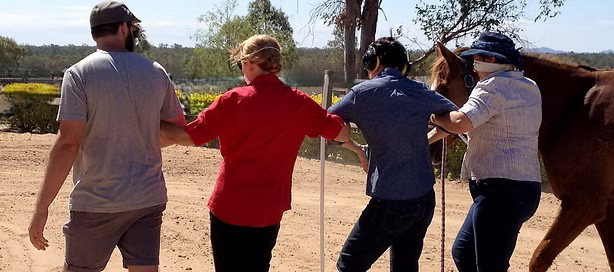
STRIDE Equine Experiences is built on a straightforward premise: horses create the conditions that frameworks can only describe.
A 500kg animal reads your energy before you’ve said a word. There is no rank in the arena. There is no performance history. There’s no way to present a version of yourself that isn’t real, because the horse simply won’t respond to it.
What happens in that moment is exactly what Hackman was talking about. The conditions shift. What Google’s researchers were measuring becomes visible. What Lencioni’s dysfunction model warns against gets surfaced, fast and safely.
Leaders who can’t ask for help in a boardroom will ask for help in the arena. The colleague who shuts down in meetings will find their voice when the task is honest and immediate. Accountability isn’t a concept anymore. It’s standing in a paddock with a lead rope and a team watching.
This isn’t a metaphor. This is what the research on experiential learning has been saying for years: people integrate feedback through experience, not information.
The frameworks work. The delivery method needs rethinking.
HR professionals have done the hard intellectual work. The models are sound. Team effectiveness is well understood as a function of conditions, trust, psychological safety, and shared accountability.
The question worth asking now is: are we delivering those insights in ways that actually change behaviour?
A two-hour workshop on psychological safety doesn’t create it. A Lencioni model diagram on a wall doesn’t build trust. Reading about Hackman’s conditions doesn’t produce them.
STRIDE doesn’t replace the frameworks. It gives them somewhere to land.
If you’re working on team effectiveness with your people and you’re ready to move from theory to something that sticks, we’d love to talk.
STRIDE works with HR leaders, L&D teams, and people professionals to design equine-assisted learning programs for corporate teams. Based in the Lower Hunter Valley, 75 minutes from Sydney.
Talk to us about a program for your team
Equine Assisted Learning is not therapy. All STRIDE activities are ground-based.